Tūpari Reserve
Tūpari is a 730 ha private reserve in the Kaituna Valley, Banks Peninsula/Te Pātaka-a-Rākaihautū, owned and managed by the Mikimiki Conservation Trust. This land and the Kaituna river have sustained people from the days of the great explorer Rākaihautū to the families who farmed here from the 1850s until 2022.
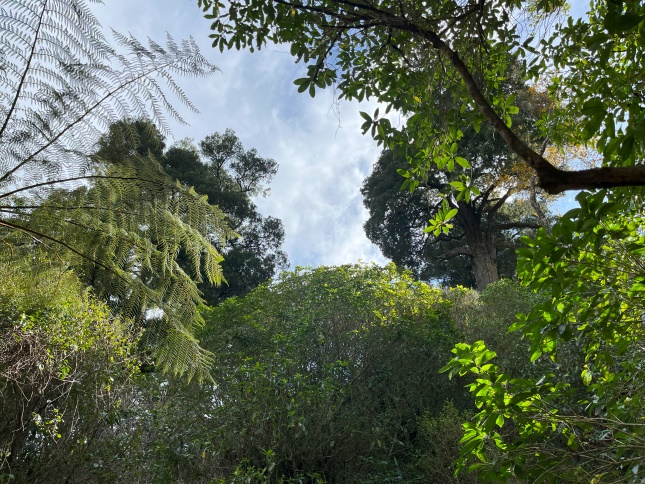
Tūpari means cliff or precipice, and the reserve is indeed very steep – it rises from 60 metres above sea level on the Kaituna valley floor to 818 metres at the highest point. This steepness means that over a relatively small distance it’s home to a diverse range of ecological habitats, from ancient mixed podocarp forests to subalpine rocky outcrops.
The ecological importance of this area was recognised in the Survey Report for the New Zealand Protected Natural Areas Programme in 1992, and the upper two thirds of the property are part of a Recommended Area of Protection. The botanist Hugh Wilson notes:
‘the diversity of this area … makes this RAP floristically valuable. It also contains some of the best mataī-dominant mid-altitude podocarp forest surviving in the District and the Region.’
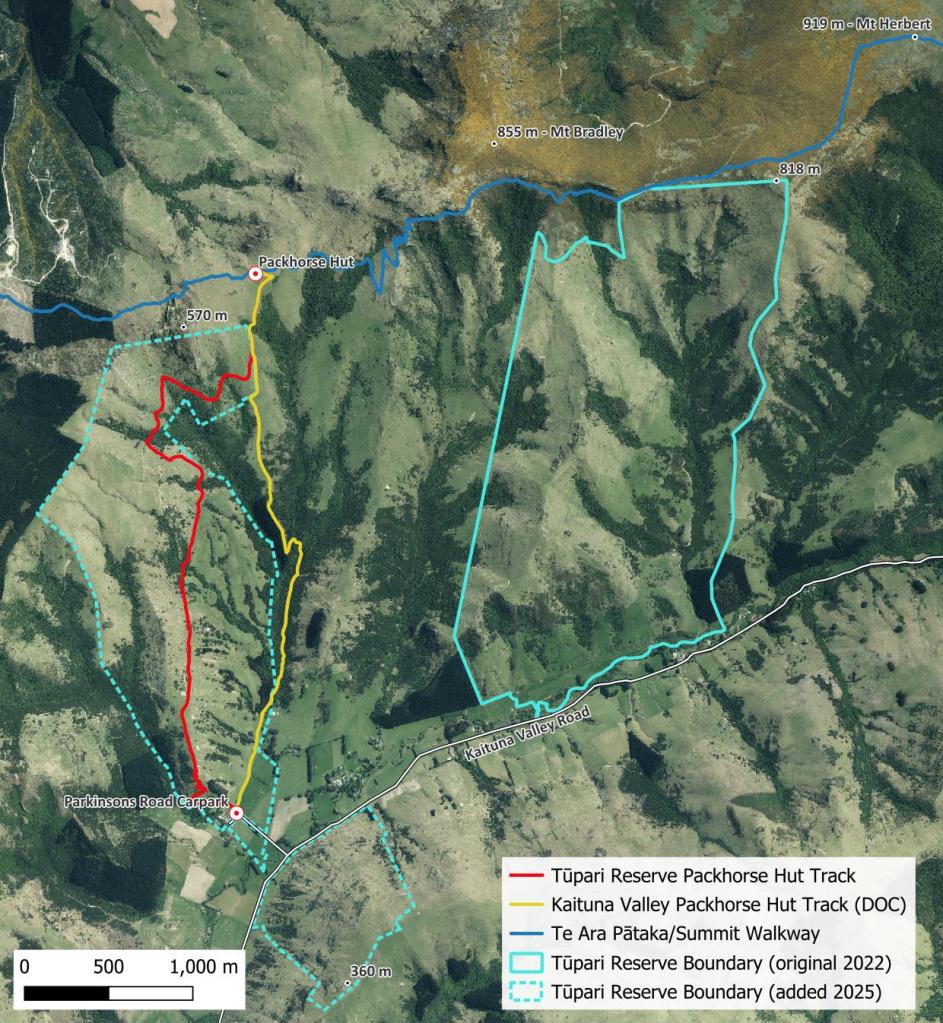
The northern boundary of Tūpari Reserve is along a ridge that lies between Mounts Bradley and Herbert/ Te Ahu Pātiki and is shared with the 500 hectare conservation block of Te Ahu Pātiki. Together with other neighbouring land to the east, there is approximately 2,000 hectares of contiguous land which is being managed for conservation. Regeneration within this larger block is more effective than islands of vegetation, which are each vulnerable at their edges.
Flora and Fauna
In 2022 the Mikimiki Conservation Trust purchased the land to preserve and enhance the ancient forest remnants and subalpine plants, together with the native animal and birds who make their home at Tūpari.
The variety of tree species include ancient mataī, kahikatea, lowland tōtara and thin-bark tōtara. Sub-alpine and rocky outcrop plant species include the silver and eastern bristle tussock, Acaena dumicola (a bidibidi only found near Mounts Bradley and Herbert/Te Ahu Pātiki) and the Banks Peninsula sun hebe, Veronica lavaudiana.
What work is being done?
The Trust follows the principles of natural regeneration. Gorse and broom are only removed where fragile alpine plants are unable to compete, and along tracks and boundaries. Gorse and broom act as nursery cover, allowing seeds from nearby forest remnants to naturally repopulate the land with vegetation suited to local conditions.
Work is also underway to exclude exotic pest species. This starts with fencing out stock and the targeted control of pest species such as possum, ferret, stoat, weasel, rabbit, rat, pig, deer, hedgehog and feral cat.
Invasive plant control is ongoing, and includes species such as old man’s beard, banana passionfruit, wilding pine, grey willow, cherry plum and ivy.
The Trust is working towards the requirements needed to provide legal protection for the ecologically significant areas of Tūpari Reserve. Over time, as natural regeneration progresses, protection will be extended to those areas of the property which are still in modified pasture.
If you would like to follow our exploits, visit us on http://www.facebook.com/tupari.reserve
Walking on Tūpari Reserve
Two walking options cross Tūpari Reserve. Both start at the Parkinsons Road carpark, Kaituna Valley, and both lead to Packhorse Hut.
1) Kaituna Valley Packhorse Hut Track (DOC) – 4.1 km / 2 hours
Managed by the Department of Conservation (DOC), the first 750 metres of this walking track crosses the lower part of Tūpari Reserve. It then leaves the reserve and follows a four wheel drive track through neighbouring farmland all the way to Packhorse Hut.
2) Tūpari Reserve Packhorse Hut Track – 5.0 km / 2.5 hours
This track stays within Tūpari Reserve for 4.5 km before joining the upper section of the DOC track near the top of the reserve. From there, it is a further 500 metres to Packhorse Hut. This option is the longer and more challenging option, but we think it is well worth it. It offers great views, no major stream crossings, no domestic stock, and several flights of stone steps to make the climb easier.
Shorter walking option – 700m / 30 minutes
Follow the Tūpari Reserve Packhorse Hut Track for 700 metres to a look out and memorial. The walk is uphill, but the stone steps and stretches under the cover of bush makes you forget the 140 metre elevation gain, and the view at the top is worth it.
If you are interested in guided group walks through other parts of the reserve, please contact us.
Please note
- Fire is the biggest threat to the reserve. Strictly no fires, camp cookers, or smoking.
- This is a walking track through a conservation area – no bikes, horses, or dogs.
- Please take all rubbish away with you.
- Please stay on the marked track to protect plants and to avoid dangerous rockfall areas.
- Please take care: some sections of the track can be slippery, trippy or stingy. Native stinging nettle / ongaonga is home to the red admiral butterfly, but its sting is seriously ouchy.
- Please supervise children in your walking group at all times.
Toilets
There are no toilets on the reserve.
- The nearest toilet is at the Kaituna Valley Scenic Reserve that is 1.5 km before the reserve on Kaituna Valley Road.
- There is also a toilet at the Packhorse Hut.
How can I help?
Tūpari is a private reserve. While the work is carried out by volunteers, we are very grateful to receive donations to help cover costs associated with track maintenance, pest animal/weed control, etc. Donations can be made via internet banking to:
Mikimiki Conservation Trust
38-9023-0706146-00
The Mikimiki Conservation Trust is a New Zealand Registered Charity. Donations over $5 are tax deductible. For a receipt please email tuparireserve@gmail.com.
About the Mikimiki Conservation Trust
The Mikimiki Conservation Trust was created in 2022. It is a registered charity (registration number CC60204) and is incorporated by the Companies Office under the Charitable Trusts Act 1957.
The trustees are Megan Reynolds, Mark Nixon and Hugh Nixon.
Contact us
If you have any questions or feedback, you are welcome to get in touch with us on email or send us a message via Facebook, or follow us on Facebook to see our regular posts.
Email: tuparireserve@gmail.com
Facebook: https://www.facebook.com/tupari.reserve

